Family offices allocate an average of 10.4% of their wealth to art. Most advisors read this as an allocation strategy. We read it as something else: a stewardship question that most governance structures are not built to answer.

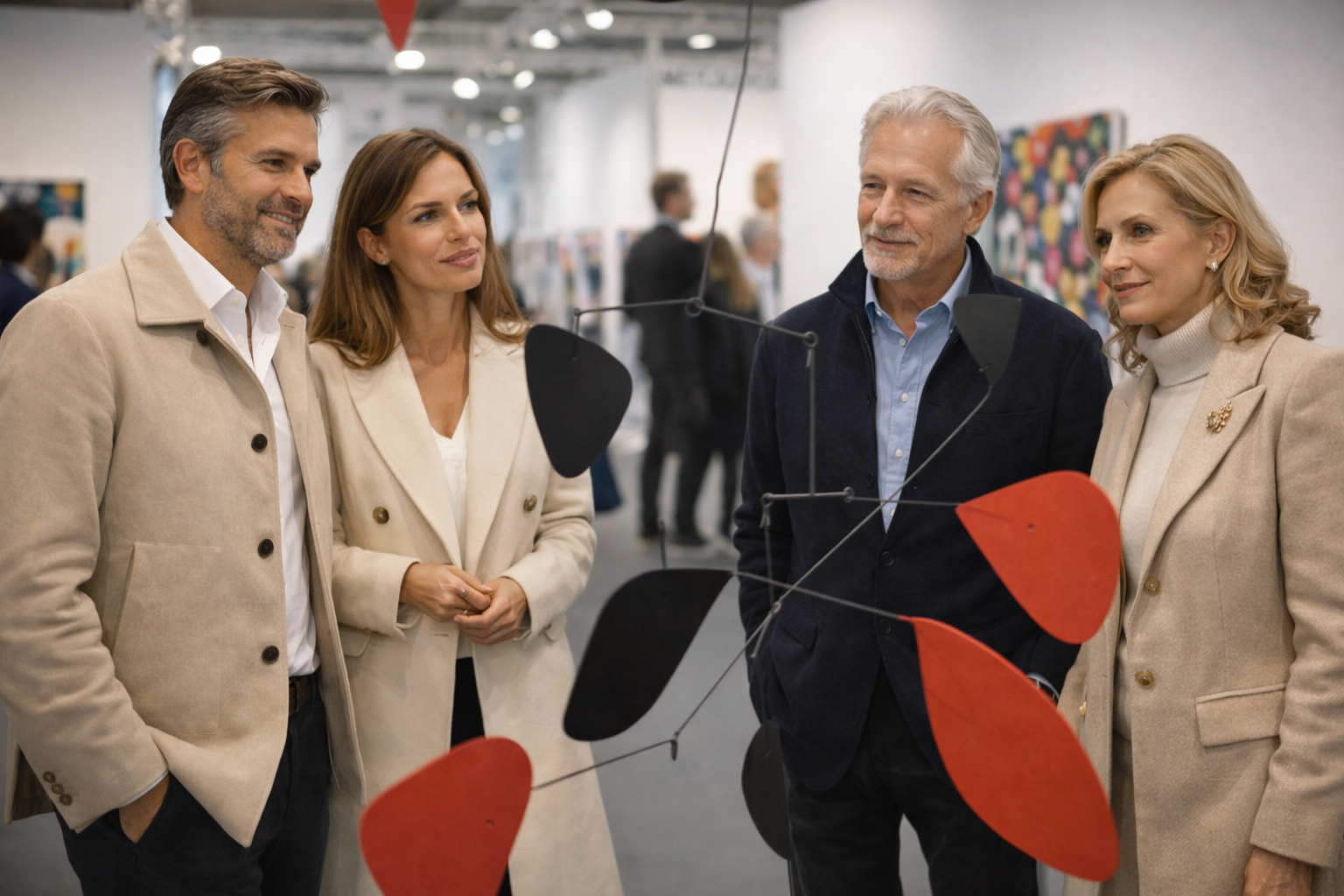
Family offices allocate an average of 10.4% of their wealth to art. The financial case is well-documented: fine art has returned an average of 10.6% annually over five decades, contemporary art delivered 13.6% annualized between 1995 and 2022, and in 2008, while public markets fell 38%, the art market moved by 4%.
But the families that build the most significant collections are not doing so because of the numbers. They are doing so because of what a collection demands — and what it reveals — about how a family governs itself.
This distinction matters. And it is almost never discussed.
Financial assets can be liquidated in minutes, divided, allocated, and restructured through instruments that treat wealth as interchangeable units. A collection resists all of this. It carries provenance. It carries aesthetic identity. It carries specific relationships — with galleries, artists, institutions — that cannot be transferred without loss.
This resistance is not a limitation. It is the point.
A family that holds a significant collection is forced to develop something that liquidity cannot provide: shared judgment. Whose voice is heard when a major acquisition is considered? How does the NextGen engage with a collection that precedes their adult lives? What happens when one branch wants to sell and another wants to preserve? These are governance questions. The collection is not their origin — but it is often their surface.
Few contemporary examples illuminate this dynamic more clearly than Bernard Arnault and the Fondation Louis Vuitton. The foundation, inaugurated in 2014 in the Bois de Boulogne, was not primarily a financial instrument. It was a governance statement — a declaration of what the Arnault family and the LVMH group intend to stand for across generations, made visible and permanent in steel and glass.
The collection held within it — spanning Richter, Basquiat, Hirst, Koons, and significant contemporary African art — was assembled over decades through relationships that no capital allocation model could replicate. The foundation institutionalizes those relationships, creates a public accountability structure around them, and binds the next generation to a cultural identity before any succession question is formally raised.
This is not philanthropy as tax strategy. It is stewardship architecture. And it represents a model that is increasingly relevant for families of significant, multi-generational wealth — not at the scale of LVMH, but in the same logic: a collection as the most visible, durable expression of what a family is building beyond financial returns.
"The families building the most significant collections today are doing so through relationships, timing, and a 20-year horizon — not allocation models. The question is whether their governance is built for the same timeframe."
Estimates suggest that nearly $1 trillion in art and collectible wealth will transfer between generations over the next decade. But the more consequential transfer is not the monetary value of the works. It is the culture of stewardship that either accompanies the collection — or fails to.
Heirs who inherit a collection without the relational and institutional context that surrounds it frequently do one of two things: they sell quickly, or they hold passively. Neither preserves the full value of what was built.
This is where governance becomes structural. A family that has developed shared practices for engaging with a collection — visiting studios, maintaining gallery relationships, making acquisition decisions across generations — has, almost without noticing, built a governance culture. One that extends far beyond the collection itself.
Every significant collection is the product of decisions made under uncertainty, across time, by people with different tastes, different risk tolerances, and different ideas about what the family stands for. In that sense, a collection is not just an asset. It is a record of governance in action — or its absence.
Families where the founding generation made all collection decisions unilaterally frequently face NextGen disengagement — from the collection, and from the broader governance structures of the family enterprise. The collection becomes a proxy for deeper questions about voice, legacy, and belonging.
These are not art questions. They are stewardship questions.
Most family offices have sophisticated structures for managing financial assets. Very few have equivalent structures for managing the intangible dimensions of family wealth — the shared values, the relational capital, the aesthetic and cultural identity that a collection embodies.
The Fondation Louis Vuitton represents one model for externalizing and institutionalizing that identity. But the underlying question is available to every family, at every scale: are we governing ourselves in a way that can steward what we have built?
That preparation begins not with an allocation decision, but with a different kind of conversation — one that most advisors are not equipped to facilitate.
CURANS works with families who are ready to ask that question. A governance and stewardship platform for multi-generational families — built to hold what wealth alone cannot answer.

The operating system for stewardship. Supporting clarity, coherence, and coordination across complex governance and long-term decision contexts.
⊕ Swiss Jurisdiction · Zurich

